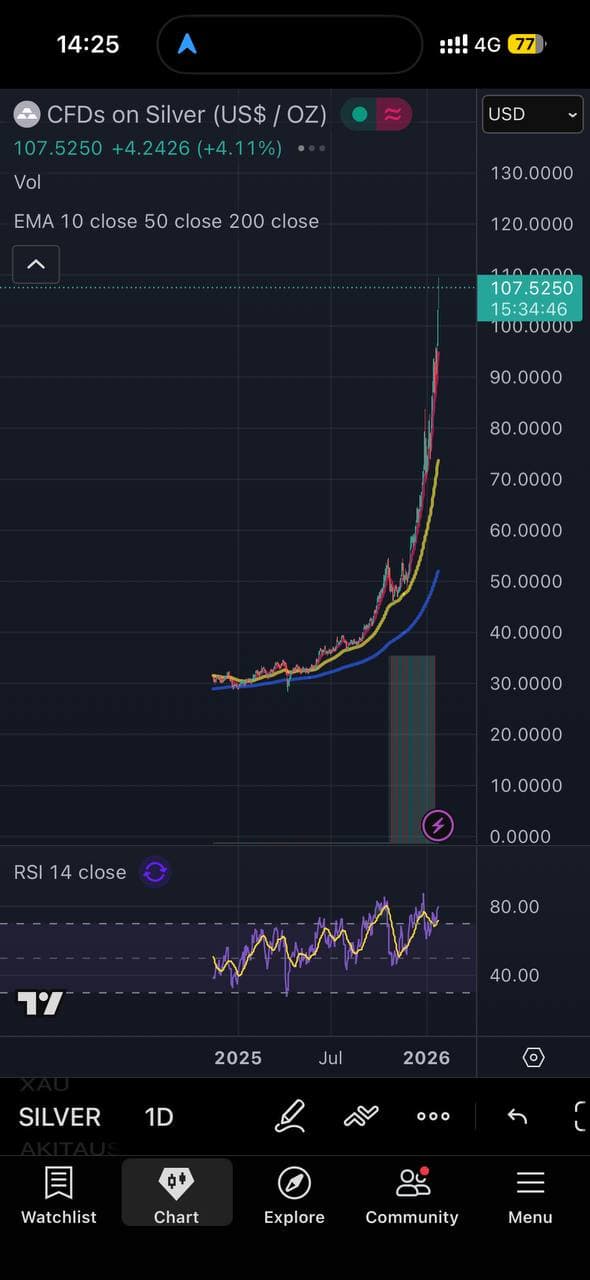
Silver just broke $107 per ounce.
If you're not paying attention to precious metals right now, you should be. This isn't a blip. This is a 3x move from where silver sat just 18 months ago.
The Numbers
Let's ground this:
- Silver: $107.52 (+4.11% today alone)
- Gold: Approaching $5,000/oz
- Silver's 2024 low: ~$22/oz
- Gain from low: ~390%
The RSI is screaming overbought. The chart has gone parabolic. Every technical indicator says "pullback imminent."
And yet.
The Man Who Bet $1 Billion
In early 2025, David Bateman—founder of Entrata, the property management software company—revealed he had purchased "close to a billion dollars in precious metals over the past six months."
To be exact: 12.69 million ounces of physical silver. That's 1.5% of the entire annual global supply.
When silver broke $100 this week, he posted:
"Congrats everyone on $100 silver. Couldn't have happened to a better group of degenerate mildly autistic misfits."
His cost basis wasn't disclosed, but with silver in the low $30s when he was accumulating, that's easily a 250%+ return on a billion-dollar position.
The Thesis
Why would someone bet a billion dollars on shiny metal?
Bateman laid out his reasoning publicly:
- The global monetary system is collapsing. What some call "The Great Reset" or Basel Endgame.
- The biggest credit bubble in history is popping. $300 trillion in global debt.
- US debt refinancing is impossible without massive printing. $28 trillion in treasuries maturing in the next 4 years.
- Trump tariffs are accelerating the timeline. By design, he argues.
- Physical possession is everything. No counterparty risk.
His most memorable line: "The whole world right now is a sophisticated game of musical chairs; the chairs are precious metals."
The Central Bank Bid
This isn't just retail speculation. According to Goldman Sachs' Rick Privorotsky, the dominant driver is structural:
"There is clearly hot money involved, but first and foremost gold is a central bank trade… a slow erosion of the dollar's exorbitant privilege rather than a sudden loss of confidence."
Central banks—particularly China, Russia, and emerging markets—have been accumulating gold at unprecedented rates. They're diversifying away from dollar-denominated assets. Silver, being both a monetary and industrial metal, rides the same wave.
The Buffett Precedent
Warren Buffett knows something about silver.
In the late 1990s, Berkshire Hathaway accumulated 129.7 million ounces—about 4,000 metric tons—of physical silver. They held through the Dot Com crash and sold around 2006 for a substantial profit.
Buffett's thesis then was supply/demand imbalance. Silver was being consumed industrially faster than it was being mined. The same thesis applies today, amplified by:
- Solar panel demand (silver is critical for photovoltaic cells)
- EV battery technology
- 5G infrastructure
- AI data center buildout
Industrial demand is structurally higher than it's ever been. Mine supply isn't keeping up.
The Bear Case
Let's be honest about the risks:
Technicals are stretched. RSI at nosebleed levels. Parabolic charts historically mean painful corrections.
Tariff policy is uncertain. The recent news that the US held off on critical mineral tariffs caused a pullback. Policy shifts can move metals violently.
Dollar strength. If the Fed stays hawkish longer than expected, dollar strength could pressure metals.
Profit-taking. After a 3x move, some holders will want to lock in gains. The question is whether new buyers absorb the selling.
What I'm Watching
I'm not a financial advisor. I'm a developer who pays attention to macro trends.
Here's what I'm watching:
- Central bank buying data — Monthly reports from World Gold Council
- COMEX inventories — Physical metal availability
- Gold-to-silver ratio — Currently around 47:1, historically averages 60:1. If silver is "catching up," there's room to run.
- Treasury auction results — Any signs of failed auctions or weak demand
- Industrial demand data — Solar installations, EV sales, data center construction
The Bigger Picture
Whether or not you buy the "collapse" thesis, something is clearly shifting.
Central banks are voting with their vaults. They're accumulating hard assets at the expense of paper claims. That's not conspiracy theory—it's observable behavior.
Silver at $107 feels surreal if you remember it at $15 in 2020. But gold at $5,000 would have seemed equally absurd then.
The game of musical chairs continues. The question is whether you want a seat.
This is not financial advice. I'm long some silver, but I'm also a software developer who spends most of my time arguing with AI about code formatting. Do your own research.
Stay Updated
Get notified about new posts on automation, productivity tips, indie hacking, and web3.
No spam, ever. Unsubscribe anytime.