Part 7 of 21
Right now, as you read this sentence, someone somewhere is launching a new crypto token. It might be the next billion-dollar protocol. It might be a dog wearing a hat. It might be an outright scam. Welcome to the wild, wonderful, occasionally terrifying world of tokens.
If you've been following this series, you know about blockchains, wallets, and smart contracts. Now it's time to understand the things that actually live on those blockchains — the tokens. Because "crypto" isn't just Bitcoin and Ethereum. There are hundreds of thousands of tokens out there, and understanding what they are (and aren't) is the difference between navigating this space and getting wrecked by it.
Coins vs. Tokens: The Difference Actually Matters
First, let's clear up something that confuses almost everyone.
A coin is the native currency of its own blockchain. Bitcoin (BTC) runs on the Bitcoin network. Ether (ETH) runs on Ethereum. Solana (SOL) runs on Solana. These are coins — they're baked into the DNA of their chain. You need them to pay transaction fees, and they're what miners or validators earn as rewards.
A token, on the other hand, is built on top of an existing blockchain using smart contracts. Think of it this way: if Ethereum is a shopping mall, then ETH is the currency the mall itself operates in, but tokens are all the individual gift cards, loyalty points, and arcade coins that the shops inside create.
USDC? That's a token on Ethereum (and other chains). Shiba Inu? Token. Uniswap's UNI? Token. They all rely on Ethereum's infrastructure to exist, but they each have their own purpose and value.
Key insight: Every coin has its own blockchain. Every token borrows someone else's.
ERC-20: The Standard That Launched a Thousand Tokens
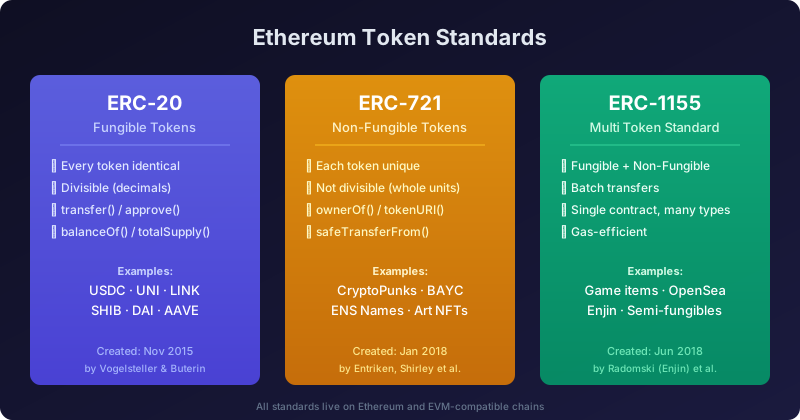
Back in November 2015, a developer named Fabian Vogelsteller (with input from Vitalik Buterin) proposed a simple idea: what if all tokens on Ethereum followed the same basic rules? What if every token could be sent, received, and checked the same way?
That proposal became ERC-20 (Ethereum Request for Comments #20), and it changed everything.
Before ERC-20, every token was a snowflake — unique code, unique behavior, a nightmare for wallets and exchanges to support. ERC-20 said: "Here's a template. Your token must be able to do these things":
- Transfer tokens from one address to another
- Check the balance of any address
- Approve another address to spend tokens on your behalf
- Report the total supply
That's basically it. A shared interface. And because every ERC-20 token speaks the same language, any wallet that supports one supports them all. Any exchange that lists one can list another. Any DeFi protocol can plug into any token.
This standard is what powered the ICO (Initial Coin Offering) boom of 2017. Suddenly, anyone could create a token in an afternoon and raise millions. Some projects were legitimate. Many were not. But the standard itself was — and remains — brilliant engineering.
Stablecoins: The Dollar, But On-Chain
If you've ever looked at crypto prices and thought "I want off this roller coaster for a bit," stablecoins are your exit ramp. They're tokens designed to maintain a stable value, usually pegged to $1 USD.
But not all stablecoins are created equal. How they maintain that peg is where things get interesting — and sometimes dangerous.
Fiat-Backed (Centralized)
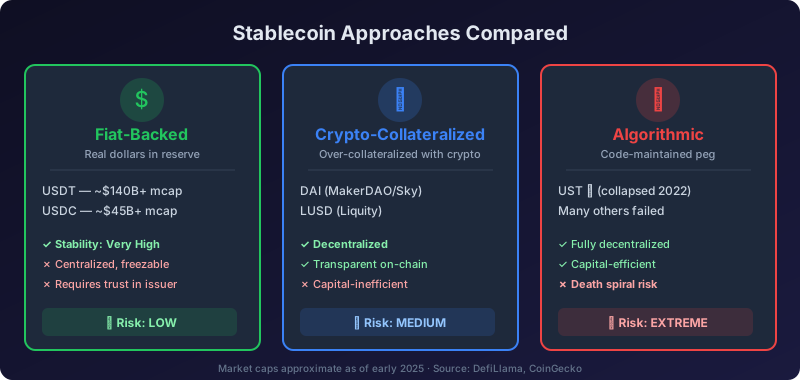
USDC (Circle) and USDT (Tether) are the big two. The idea is simple: for every token in circulation, there's a real dollar (or equivalent) sitting in a bank account somewhere. You want to redeem your USDC for actual dollars? Circle says "sure, here you go."
- USDC: Transparent, audited regularly, the "good boy" of stablecoins
- USDT: Larger market cap (~$140B+), murkier reserves, perpetually controversial — but stubbornly dominant. You can track stablecoin market caps in real time on DefiLlama.
Crypto-Collateralized (Decentralized)
DAI (MakerDAO, now rebranded as Sky) takes a different approach. There's no bank account. Instead, users lock up more crypto than the DAI they mint. Want to create 100 DAI? You might need to lock up $150 worth of ETH as collateral. If your collateral drops in value, the system liquidates it automatically.
It's more complex, but it's truly decentralized. No company can freeze your DAI.
Algorithmic (Here Be Dragons)
And then there's the algorithmic approach, where code alone tries to maintain the peg using supply-and-demand mechanics. No reserves. No collateral. Just math and incentives.
This is what Terra/UST tried. For a while, it worked. UST held its peg — helped by the Anchor Protocol offering ~19.5% yields — and its companion token LUNA soared to an all-time high of $119.51. Then on May 9, 2022, it didn't work. UST lost its peg, LUNA entered a death spiral, and ~$45 billion in market cap evaporated in a week. People lost their life savings. Some lost more than that. Terraform Labs filed for bankruptcy in January 2024, and founder Do Kwon was later extradited to face fraud charges.
The lesson: When someone promises you a "stable" asset backed by nothing but an algorithm and vibes, be extremely skeptical. If the peg mechanism relies on confidence alone, it only works until it doesn't.
NFTs: Non-Fungible Tokens
Everything we've covered so far — ERC-20s, stablecoins, memecoins — are fungible. One USDC equals any other USDC. But what about unique digital items? A piece of art, a concert ticket, a domain name?
That's where NFTs (Non-Fungible Tokens) come in. They use different standards — ERC-721 for unique items and ERC-1155 for mixed collections — to represent one-of-a-kind digital ownership on-chain.
NFTs got a wild reputation during the 2021 boom (and the crash that followed), but the underlying technology of provable digital ownership is genuinely powerful — far beyond profile pictures.
We dedicate the entire next chapter to NFTs: the boom, the bust, the real use cases, and why the technology still matters. Don't skip it.
Memecoins: The Casino Is Open
Let's talk about the elephant — or rather, the dog — in the room.
Dogecoin started as a literal joke in 2013. It now has a market cap of billions. Shiba Inu was created as a "Dogecoin killer" and also became a multi-billion dollar asset. PEPE rode the frog meme to a peak market cap over $1 billion. WIF (dogwifhat) is a dog wearing a hat. That's it. That's the thesis.
Memecoins have no utility, no technology, no roadmap. They have culture. They have community. And they have the raw, unfiltered energy of people who'd rather gamble on a cartoon frog than buy index funds.
Platforms like pump.fun on Solana made it possible to launch a memecoin in under a minute for a few dollars. This spawned an explosion of token launches — thousands per day — most going to zero within hours, a few making early buyers absurdly rich.
Real talk: Memecoins are gambling. Some people win big. Most people lose. If you play this game, only use money you genuinely don't care about losing. The house — meaning the early insiders — almost always wins.
SPL Tokens: Solana's Take
Everything I've described so far has been Ethereum-centric, but Ethereum isn't the only game in town. Solana has its own token standard called SPL (Solana Program Library).
SPL tokens work conceptually the same as ERC-20 tokens — fungible, transferable, standardized — but they benefit from Solana's speed and low fees. Creating and transferring SPL tokens costs fractions of a cent, which is exactly why Solana became the home of the memecoin explosion. When launching a token costs almost nothing, people launch a lot of tokens.
Other chains have their own standards too: BEP-20 on BNB Chain, TRC-20 on Tron, and so on. The concept is always the same. The implementation details differ.
Anyone Can Create a Token (And That's Terrifying)
Here's something that blows people's minds: you could create your own token right now. With some basic tools and a few dollars in gas fees on Ethereum (or pennies on Solana), you could deploy a token called JoeCoin and have a million units in your wallet by lunchtime.
This is genuinely powerful. It means any project, community, or creator can launch a token without asking permission from a bank, a government, or a tech company. It's financial Lego.
It's also genuinely dangerous. Because if anyone can create a token, then scammers can too. And they do. Constantly. Common traps include:
- Rug pulls: Creator launches token, hypes it up, then drains all the liquidity and disappears
- Honeypots: You can buy the token but the code prevents you from selling
- Fake tokens: A token named "Ethereum 2.0" that has nothing to do with Ethereum
How Tokens Launch
Not all token launches look the same:
- Fair launch: No pre-mine, no insider allocations. Everyone gets in at the same time. Bitcoin is the original fair launch. In practice, truly fair launches are rare.
- Presale / ICO / IDO: Early investors buy tokens before public launch, usually at a discount. The project raises funds to build. The risk? Those early investors often dump on retail the moment trading opens.
- Airdrops: Free tokens distributed to early users of a protocol. Uniswap's UNI airdrop gave ~$1,500 worth of tokens to anyone who'd used the platform. These can be life-changing — or worthless.
Tip: When evaluating any token launch, check the token distribution. If 50% of the supply goes to the team and insiders, you're the exit liquidity. Look at vesting schedules, total supply, and who holds the biggest bags.
What Actually Gives a Token Value?
This is the million-dollar question. A token is just code. What makes one worth $0.000001 and another worth $1,000?
Utility. Does the token do something? ETH pays for gas. LINK pays Chainlink oracle operators. Tokens with real demand from real usage have a floor.
Governance. Some tokens let you vote on protocol decisions. UNI holders govern Uniswap. If the protocol controls billions in value, having a say in its direction is worth something.
Speculation. Let's be honest — most token value is driven by people betting the price will go up. There's nothing inherently wrong with this (stocks work similarly), but speculation without substance is a house of cards.
Scarcity. Fixed supply plus growing demand equals higher prices. Bitcoin's 21 million cap is the ultimate example.
Network effects. The more people use a token, the more useful it becomes, the more people want it. This flywheel is what separates tokens that last from tokens that don't.
In practice, most tokens derive their value from some combination of all five. The healthiest tokens have strong utility and speculation. The most dangerous have only speculation.
What's Next
Now that you understand what tokens are — how they're created, what standards they follow, and what gives them value — it's time to explore one of the most visible (and controversial) use cases for those standards. In Part 8, we're diving into NFTs — non-fungible tokens. They're way more than overpriced JPEGs. From digital art and gaming assets to real-world ownership and identity, NFTs represent a fundamental shift in how we think about digital property.
See you there.
Stay Updated
Get notified about new posts on automation, productivity tips, indie hacking, and web3.
No spam, ever. Unsubscribe anytime.