Part 17 of 21
Imagine you've spent ten years building a following on Instagram. A million followers. Brand deals. A real business. Then one morning you wake up, open the app, and your account is gone. Disabled. No warning, no appeal, no recourse. A decade of work — wiped out by a content moderation algorithm that flagged the wrong post.
This isn't hypothetical. It happens constantly. And it reveals something uncomfortable about the internet we've all been using: you don't actually own anything on it.
Web3 is the movement trying to change that. Let's talk about what it means — and whether it's actually working.
The Three Eras of the Internet
People love neat narratives, and the Web1 → Web2 → Web3 framework is almost too clean. But it's useful:
- Web1 (1990s–2004): Read-only. Static pages. You consumed content that someone else published. Think GeoCities, early Yahoo, encyclopedia sites. The internet was a digital library.
- Web2 (2004–present): Read-write. User-generated content. You could publish, comment, share, create. Think YouTube, Instagram, Twitter, TikTok. The internet became a platform.
- Web3 (emerging): Read-write-own. You can create and own what you create — your content, your identity, your data, your relationships with your audience. The internet becomes infrastructure you have a stake in.
The key shift isn't technological. It's about who controls the value you create.
In Web2, you create the content, but the platform captures the value. Your tweets make Twitter valuable. Your videos make YouTube valuable. Your photos make Instagram valuable. But you can't take your followers to a competitor. You can't export your algorithmic reputation. You're a digital sharecropper — farming land you'll never own.
Web3 says: what if the users owned the platforms themselves?
The Ownership Problem Is Real
Before we get into solutions, let's be honest about the problem. It's bigger than most people realize:
- Your Spotify playlists? Spotify's, not yours. They can remove songs, change the interface, or shut down entirely. You're renting access to music.
- Your Steam game library? You own licenses, not games. Valve can revoke access at any time. You spent $3,000 on games you can never resell.
- Your Instagram followers? Instagram's. Get banned and they're gone. You can't email them, you can't migrate them.
- Your Google Docs? Google's servers, Google's rules. They've locked people out of their entire digital lives over automated policy violations.
This isn't a conspiracy — it's the business model. Free services need to monetize somehow, and that means you are the product, not the customer. Your data, your attention, your social graph — all owned by corporations that answer to shareholders, not users.
The core insight of Web3: If blockchains let us own digital money without a bank, why can't they let us own digital everything without a platform?
DAOs: Internet-Native Organizations
One of the most ambitious ideas to come out of Web3 is the DAO — a Decentralized Autonomous Organization. Think of it as a company that runs on code instead of corporate law.
Here's how a traditional company works: shareholders elect a board, the board hires executives, executives make decisions. Information flows through hierarchies. If you own stock in Apple, you technically have a vote — but good luck influencing anything.
A DAO flips this. Token holders vote directly on proposals. The rules are encoded in smart contracts. The treasury is on-chain and transparent. There's no CEO with a corner office — there's a community with a group chat.
Some notable DAOs:
- MakerDAO — Governs the DAI stablecoin (now rebranded as part of the Sky ecosystem, with DAI becoming USDS and MKR becoming SKY). Token holders vote on risk parameters like collateral types and interest rates. It's essentially a decentralized central bank with billions in assets.
- Uniswap Governance — The largest decentralized exchange is governed by UNI token holders who vote on fee structures, treasury spending, and protocol upgrades.
- Nouns DAO — One NFT is auctioned every single day. Each Noun NFT gives you one vote in the DAO's treasury, which funds public goods and creative projects. It's like a weird, wonderful art collective with a massive war chest.
- ConstitutionDAO — In November 2021, thousands of strangers on the internet pooled $47 million in ETH to try to buy an original copy of the U.S. Constitution at a Sotheby's auction. They were outbid at $43.2 million — the organizers couldn't go higher because they needed funds to insure, store, and transport the document. The DAO disbanded shortly after, but proved that internet strangers could coordinate capital at scale in days.
Think of DAOs like this: If a subreddit could have a bank account and legally binding votes, you'd have something close to a DAO.
How Governance Actually Works
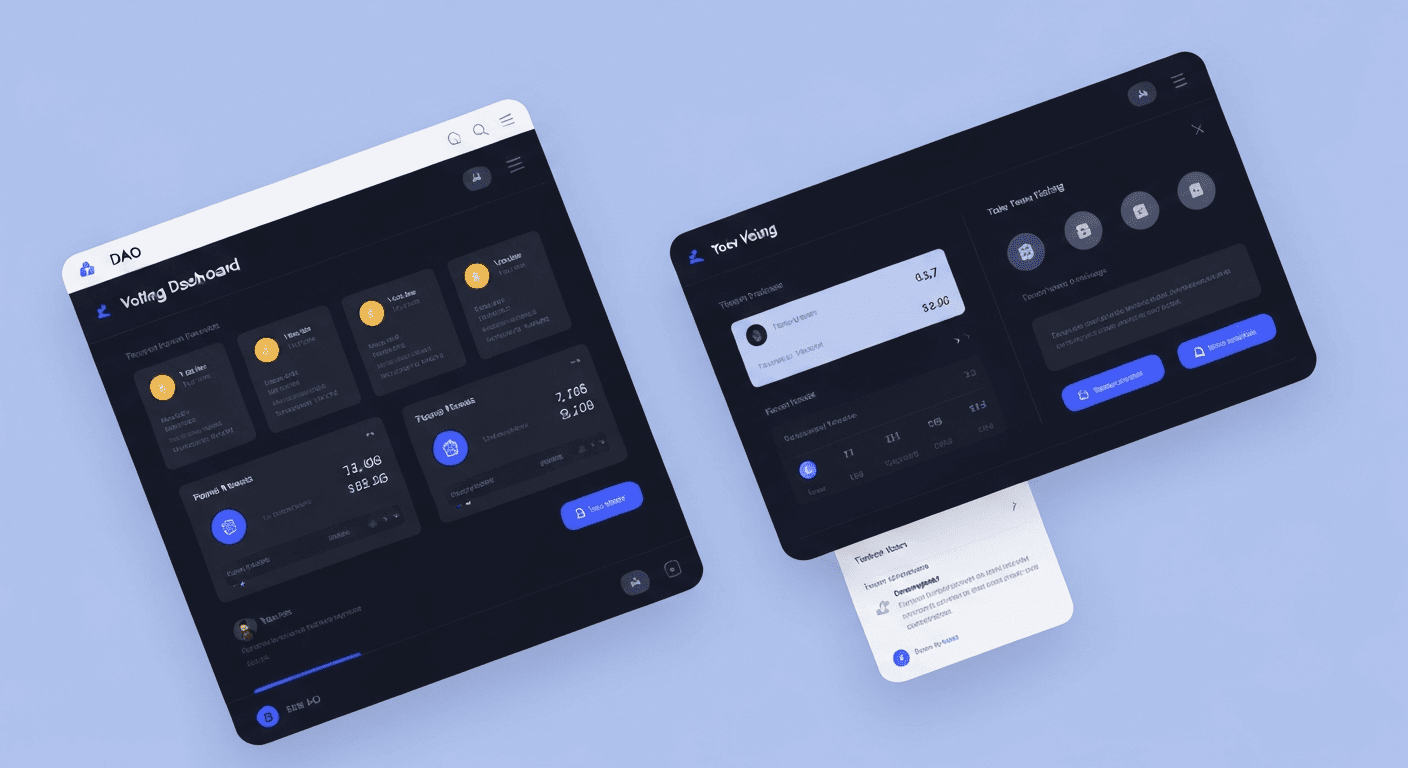
DAO governance typically follows this pattern:
- Someone writes a proposal — "Let's spend $500K from the treasury to fund developer grants"
- Community discusses it — Usually on a forum (Discourse, Commonwealth) before it goes to a vote
- Token holders vote — One token usually equals one vote. Voting happens on-chain or through Snapshot voting (off-chain but verifiable)
- If it passes, code executes — Smart contracts can automatically release funds, change parameters, or trigger actions
There's also delegation — you can delegate your voting power to someone you trust, similar to representative democracy. Don't have time to read every proposal? Delegate to a community member who does.
It's messy, slow, and sometimes dysfunctional — just like regular democracy. But it's transparent in ways traditional governance never is. Every vote, every treasury movement, every decision is public and auditable.
Decentralized Identity: You Are Your Wallet
In Web2, your identity is scattered across dozens of platforms. Your LinkedIn profile, your Twitter handle, your email address — all controlled by different companies, none portable.
Web3 introduces the idea of self-sovereign identity. Your wallet address becomes your universal login. But raw wallet addresses (0x7a3F...9b2E) aren't exactly user-friendly, which is where projects like ENS come in.
ENS (Ethereum Name Service) lets you register a human-readable name like yourname.eth. It works like a domain name for your wallet — and for your identity. You can attach your website, social profiles, email, and more to a single ENS name that you own. No company can take it away. As of today, over 600,000 owners hold more than 1.3 million ENS names, with integrations across wallets like Coinbase Wallet, Rainbow, and browsers like Brave.
Beyond names, there's the concept of on-chain reputation. Your wallet's history tells a story:
- Which protocols have you used?
- How long have you been active?
- Have you participated in governance?
- What communities are you part of?
Projects are experimenting with soulbound tokens — non-transferable NFTs that represent credentials, memberships, or achievements. Think of them as on-chain badges that prove you attended an event, completed a course, or contributed to a project. A resume that can't be faked.
Social Protocols: Decentralized Social Media
If platforms own your social graph, the obvious Web3 answer is: build social networks where users own their accounts, followers, and content.
Farcaster is the most interesting attempt so far. It's a decentralized social protocol (think: decentralized Twitter) where:
- Your identity is tied to your wallet, not an email address
- Your social graph lives on a decentralized network, not a company's server
- Any developer can build a client (app) on top of the protocol — the most popular being Warpcast
- If you don't like one app, switch to another — your followers come with you
Lens Protocol has evolved from a social graph into a full SocialFi platform — a dedicated chain (built on ZKSync and Avail) with social primitives baked in. Accounts, usernames, graphs, feeds, and groups are all on-chain building blocks that any developer can plug into. Users get gasless transactions settled in GHO, and can switch between apps while keeping their data portable.
These platforms are still early and niche. But the idea is powerful: what if switching social networks was as easy as switching email clients? Your data stays yours; the apps just provide different interfaces.
Where Web3 Data Actually Lives
A lot of early Web3 NFT artwork and dApp data still lives on regular old servers. If that server goes down, your "decentralized" asset points to a dead link. Not exactly the revolution.
That's where decentralized storage comes in:
- IPFS (InterPlanetary File System) — A peer-to-peer network where files are addressed by their content hash, not their location. Instead of "this file lives at amazon.com/server5/image.jpg," it's "this file has fingerprint QmX7b3...". Anyone hosting a copy can serve it. Data is open, verifiable, and resilient — if one node goes offline, others can still serve the content.
- Arweave — Permanent storage. You pay once, and your data is stored forever (in theory) across a decentralized network. As the project describes itself: "like Bitcoin, but for data." Think of it as the Internet Archive, but trustless.
- Filecoin — A marketplace for storage. People with spare hard drive space rent it out; people who need storage pay for it. Supply and demand for data hosting.
These aren't just crypto curiosities. If Web3 is about ownership, you need somewhere to store what you own that isn't controlled by Amazon, Google, or Microsoft.
The Creator Economy, Reimagined
This is where Web3 gets genuinely exciting — and where it's already showing real results.
In Web2, the creator economy has a middleman problem:
- Musicians get fractions of a cent per Spotify stream
- Writers depend on platform algorithms for visibility
- Artists sell through galleries that take 50% commissions
- Everyone relies on platforms that can change the rules overnight
Web3 offers a different model. Smart contracts enable direct relationships between creators and fans:
- Musicians can sell music NFTs directly, with smart contracts that pay royalties on every resale — forever
- Writers can tokenize their work, giving supporters ownership stakes in the content they fund
- Artists can sell directly to collectors, with programmable royalties built into the contract
- Creators can issue tokens to their most engaged fans, creating community ownership
The creator doesn't need to trust a platform to distribute revenue fairly — the code does it automatically. And because the fan relationship is on-chain, no platform can take it away.
The Skeptic's View
Alright, let's be honest. Web3 has real problems, and ignoring them doesn't help anyone.
The complexity argument. Try explaining to your parents how to set up a MetaMask wallet, bridge ETH to an L2, connect to a dApp, and vote on a DAO proposal. Web2 won because it was easier than what came before. Web3 is currently harder. That's a real barrier.
The "solution looking for a problem" critique. Do most people actually care about owning their social graph? Or do they just want an app that works? For the average user, Instagram's convenience beats Farcaster's philosophy every day of the week.
Governance fatigue. Most DAO token holders don't vote. Voter turnout is often below 10%. The people who do participate tend to be whales (large token holders), which means "decentralized governance" can look a lot like plutocracy — rule by the richest.
Speculation dominance. Too much of Web3 is still driven by speculation rather than utility. When most people buy governance tokens, they're hoping the price goes up — not planning to vote on proposal #247 about treasury diversification.
These are fair critiques. But here's the thing: the early internet had the same problems. Email was confusing. Websites looked terrible. Skeptics called it a fad. The technology matured, the UX improved, and the use cases became undeniable.
Web3 might follow the same path — or it might not. The honest answer is that we don't know yet. But the underlying idea — that users should own their digital lives — is hard to argue against. The question is whether blockchain is the right tool to get there.
My take: Web3's vision is right. The execution is still catching up. The projects that win will be the ones where users don't even realize they're using a blockchain — they just notice that things work better and they have more control.
Key Takeaways
- Web3 = read-write-own. The evolution from consuming content to creating it to owning it
- DAOs are internet-native organizations governed by token holders through on-chain voting
- Decentralized identity (ENS, soulbound tokens) gives you a portable, self-sovereign digital identity
- Social protocols like Farcaster aim to let users own their social graph across applications
- Decentralized storage (IPFS, Arweave, Filecoin) ensures Web3 data isn't dependent on centralized servers
- The creator economy benefits enormously from direct, programmable relationships between creators and fans
- The challenges are real — UX complexity, governance apathy, and speculation still dominate the space
What's Next
We've covered the theory — blockchains, DeFi, NFTs, and now Web3. But what does all this look like in practice? In Part 18, we'll explore real-world applications — the places where crypto is already making a tangible difference outside of trading and speculation. Supply chains, remittances, digital identity in developing nations, and more. The rubber meets the road.
Stay Updated
Get notified about new posts on automation, productivity tips, indie hacking, and web3.
No spam, ever. Unsubscribe anytime.