
Part 14 of 21
What if I told you there's a type of crypto trading that does more daily volume than all of DeFi's lending, swapping, and yield farming combined? And that it used to be exclusively controlled by centralized exchanges — until a team with zero VC funding built an entire blockchain from scratch just to change that?
Welcome to the world of perpetual futures. This is where serious money moves, where traders make (and lose) fortunes in minutes, and where one of crypto's most impressive technical achievements — Hyperliquid — is quietly eating Binance's lunch.
Buckle up. This is a big one.
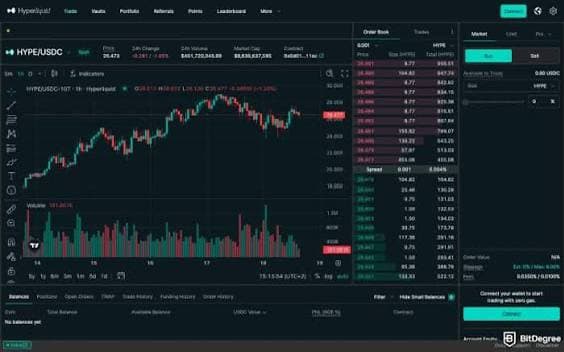
What Are Perpetual Futures?
Let's start simple. A futures contract is a bet on where the price of something is going. You don't buy the actual asset — you buy a contract that pays you if the price goes up (or down, depending on your position).
Traditional futures have an expiry date. Oil futures expire in March. Wheat futures expire in June. When expiry hits, the contract settles and you're done.
Perpetual futures (or "perps") are the crypto twist: they never expire. You can hold your position for five minutes or five months. There's no settlement date, no rolling over contracts. It's an endless bet on price.
Think of it like renting vs. owning. Spot trading is buying a house — you own the ETH. Perps are like renting — you get exposure to the price without actually holding the asset. And just like rent, you pay a small ongoing fee to keep your position open.
How Perps Stay Pegged: Funding Rates
Here's the clever part. If perpetual contracts never expire, what stops them from drifting away from the actual spot price? The answer is funding rates — a mechanism so elegant it deserves its own explanation.
Every few hours (typically every 8 hours), traders on one side pay traders on the other:
- When more people are long (betting price goes up): longs pay shorts. This discourages piling into longs and pushes the perp price back down toward spot.
- When more people are short (betting price goes down): shorts pay longs. Same logic in reverse.
The rate fluctuates based on supply and demand. During a massive bull run, funding rates can spike — meaning it gets expensive to be long. During a crash, it flips, and shorts pay through the nose.
💡 Pro insight: Savvy traders actually farm funding rates. They buy spot and short perps simultaneously, capturing the funding payments while being market-neutral. It's called a "cash-and-carry" trade, and it's one of the lower-risk strategies in crypto.
Long, Short, Leverage, Liquidation — The Basics
Let's demystify the jargon:
- Going long = betting the price goes up. You profit when price rises.
- Going short = betting the price goes down. You profit when price falls. (This is a big deal — on spot markets, you can't short. You can only sell what you have.)
- Leverage = borrowing power. With 10x leverage, your $100 acts like $1,000. A 10% move in your favor means 100% profit. But a 10% move against you...
- Margin = the collateral you put up. It's your "skin in the game" that backs the leveraged position.
- Liquidation = when the market moves against you enough that your margin is wiped out. The protocol force-closes your position. Your money is gone. It happens fast.
Think of leverage like driving speed. 2x leverage is cruising at 60mph — reasonable, manageable. 10x is 300mph — exhilarating until something goes wrong. 50x or 100x? You're strapping yourself to a rocket. Most rockets explode.
⚠️ Reality check: The vast majority of leveraged traders lose money. Exchanges make a fortune from liquidations. If you're a beginner, watch and learn before you touch leverage. And if you do, start at 2-3x max. Seriously.
Why Trade Perps at All?
If perps are so risky, why do they dominate crypto trading volume? A few reasons:
- Shorting: On spot markets, you can only sell what you own. Perps let you profit from falling prices — essential for hedging or trading bear markets.
- Leverage: Sometimes you want amplified exposure. A disciplined trader using 2-3x leverage with tight stop-losses can be highly capital efficient.
- Hedging: If you're holding a bag of ETH you don't want to sell (maybe you're staking it), you can short ETH perps to protect against downside. Your spot position and perp position offset each other.
- Capital efficiency: Why lock up $10,000 in spot when you can get the same exposure with $1,000 on perps and deploy the rest elsewhere?
- No expiry hassle: Unlike traditional futures, you don't need to manage rolling positions. Open it, set your stops, walk away.
For years, this was all happening on centralized exchanges. Binance, Bybit, OKX — they processed billions in perp volume daily. But they had a problem: you had to trust them with your money. And as FTX proved, that trust can be catastrophically misplaced.
Enter decentralized perp DEXs. Enter Hyperliquid.
Hyperliquid: The Exchange That Built Its Own Blockchain
This is where I get genuinely excited. Hyperliquid isn't just another perp DEX — it's a case study in what happens when obsessive engineers refuse to compromise.
The Origin Story
Most DeFi protocols launch on an existing blockchain. Ethereum, Arbitrum, Solana — pick your chain, deploy your contracts, ship it. But the Hyperliquid team (led by Jeff Yan, a Harvard math/CS grad and former quant trader) had a problem: no existing chain was fast enough.
They wanted to build a fully on-chain order book — every order, every cancellation, every trade recorded on the blockchain. To match the speed of centralized exchanges (we're talking sub-second execution), they needed a chain that could handle tens of thousands of transactions per second with sub-second finality.
So they built one. From scratch.
HyperBFT is Hyperliquid's custom Layer 1 consensus mechanism, inspired by Meta's HotStuff protocol and its successors. It's optimized for one thing: being the fastest possible settlement layer for a trading exchange. The L1 currently supports up to 200,000 orders per second with sub-second block finality — and throughput is constantly improving as the node software is further optimized.
The result? An order book that runs entirely on-chain with the speed of a CEX and the transparency of a blockchain. Every trade is verifiable. No hidden market makers. No exchange trading against its own users. No "we swear we didn't see your stop-loss and hunt it."
Fully On-Chain Order Book (Not an AMM!)
This distinction matters. Most DeFi exchanges use AMMs (automated market makers) — those liquidity pools we covered earlier in this series. AMMs are great for simple swaps, but they're terrible for serious trading. The slippage is bad, capital efficiency is poor, and you can't do sophisticated order types.
Hyperliquid runs a central limit order book (CLOB) — the same type of system that powers the NYSE, Nasdaq, and Binance. Limit orders, market orders, stop-losses, take-profits — they all work exactly like you'd expect from a real exchange. The difference is that the matching engine lives on a blockchain instead of in Binance's data center.
Why does this matter?
- Transparency: You can verify every trade, every order, every liquidation on-chain. No more wondering if the exchange is front-running you.
- Self-custody: Your funds live in your wallet until the moment they're used. No depositing to a centralized custodian and praying they don't pull an FTX.
- Censorship resistance: No KYC (for now), no account freezes, no geographic restrictions. A trader in Lagos has the same access as a trader in London.
No VC Funding — Community First
Here's what makes Hyperliquid culturally unique in crypto: they took zero venture capital money. No Andreessen Horowitz. No Paradigm. No Sequoia. The team self-funded development.
Why does this matter? Because in crypto, VC-funded projects have a nasty habit of treating their community as exit liquidity. VCs get cheap tokens early, then dump them on retail. Hyperliquid flipped that model on its head.
The $HYPE Airdrop
On November 29, 2024, Hyperliquid executed one of the largest and most celebrated airdrops in crypto history. They distributed 31% of the total HYPE token supply — 310 million tokens out of a 1 billion total supply — to early users of the platform. The remaining allocation reserved 38.888% for future emissions and community rewards, and 30.112% for team and contributors (with a vesting schedule).
No insider allocation games. No tiered structures favoring whales. People who had been actively trading on the platform received life-changing amounts of tokens. Some early adopters received hundreds of thousands of dollars worth of HYPE.
The token launched at around $2 and quickly ripped past $30 within weeks. The community went absolutely feral (in the best way). To this day, HYPE holders are some of the most loyal and vocal in all of crypto — because the team earned that loyalty by putting users first. The protocol also uses trading fee revenue to conduct ongoing HYPE buybacks through its Assistance Fund, creating constant buy pressure.
💡 Note: The HYPE airdrop became the gold standard for how to launch a token. Fair distribution, rewarding actual users, no VC dumping. Every project since gets compared to it.
HyperEVM: From Exchange to Ecosystem
Hyperliquid started as a perps exchange, but the team had bigger plans. With the launch of HyperEVM in February 2025 — a general-purpose EVM (Ethereum Virtual Machine) compatible execution environment — Hyperliquid became a full-fledged blockchain ecosystem.
Crucially, HyperEVM is not a separate chain. It runs under the same HyperBFT consensus as HyperCore (the order book layer), meaning EVM smart contracts can directly read prices from and send orders to the native spot and perp order books. A lending protocol can liquidate positions through HyperCore's order books in just a few lines of Solidity code. This tight integration is a massive architectural advantage.
This means developers can now build any type of DeFi application on Hyperliquid: lending protocols, stablecoins, NFT marketplaces, whatever. All of these apps can natively interact with the Hyperliquid order book and the liquidity it provides. You can explore the growing ecosystem at HypurrCo or HL Eco.
It's an ambitious play: build the best exchange first, attract liquidity, then expand into an entire financial ecosystem anchored by that liquidity. Think of it like Amazon starting with books and expanding to... everything.
Vaults and Builder Codes
Two more features worth highlighting:
Vaults are Hyperliquid's answer to copy trading. Top traders can create vaults that others deposit into. The vault automatically mirrors the trader's positions. It's like a decentralized hedge fund — you can follow a skilled trader's strategy without managing trades yourself.
Builder codes are an ecosystem incentive mechanism. Developers who build frontends, tools, or integrations for Hyperliquid can attach their builder code to trades routed through their applications, earning a share of trading fees. It's like an affiliate program baked into the protocol itself.
The Numbers Speak
As of early 2026, Hyperliquid regularly processes $5-10 billion in daily trading volume — putting it in direct competition with the derivatives offerings of major centralized exchanges. For a protocol that launched its token barely a year ago, with no VC backing, these numbers are staggering.
The platform supports 100+ trading pairs, with leverage up to 50x on major assets. And all of it is running on-chain, fully transparent, with sub-second execution times. The exchange has also become a hub for commodities trading — with silver and gold markets regularly generating hundreds of millions in daily volume — and for pre-launch token speculation.
The Wider Perp DEX Landscape
Hyperliquid is the current king, but it didn't build in a vacuum. Here's how the other major perp DEXs compare:
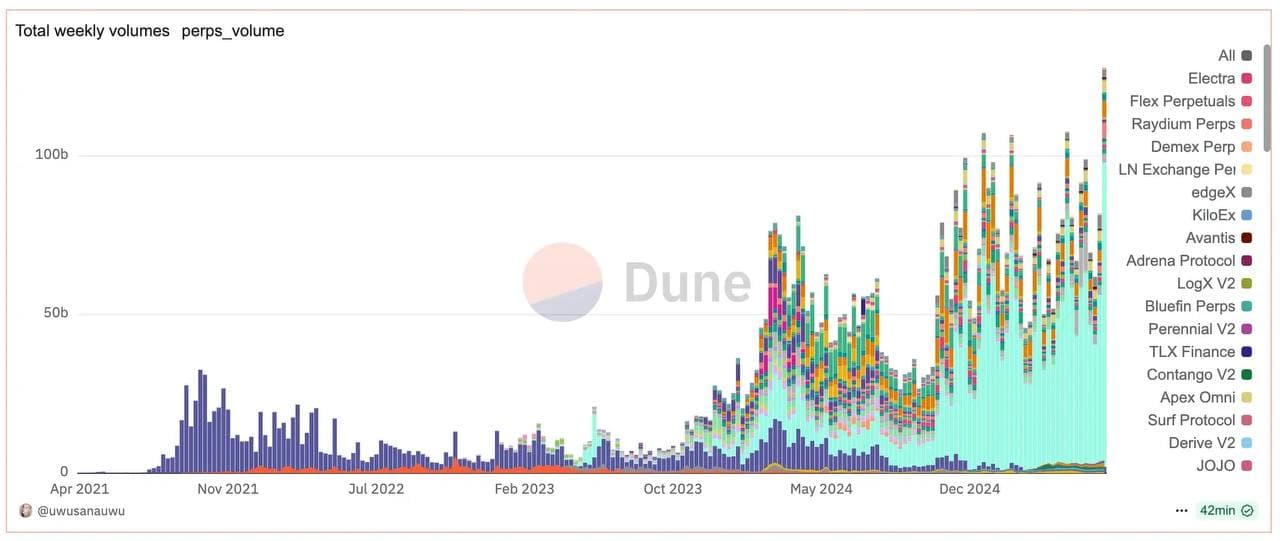
dYdX — The OG
dYdX was the first serious decentralized perpetuals exchange. Originally built on Ethereum (then StarkWare for scaling), the team made the bold move of migrating to their own Cosmos-based blockchain (dYdX Chain) in late 2023. They wanted full control over the validator set and fee structure. With over $1.5 trillion in lifetime volume and 220+ markets, it's a solid platform with deep history, though Hyperliquid has overtaken it in daily volume and mindshare.
GMX — The Real Yield Pioneer
GMX introduced a model that got DeFi degens excited. In V1 it was the GLP pool; in the current V2, it evolved into GM Pools — isolated liquidity pools per trading pair, improving risk management. Liquidity providers deposit assets into these pools, and traders trade against them using Chainlink Data Stream oracle prices. When traders lose (and statistically, most do), LP holders profit. GMX popularized the concept of "real yield" — earning fees from actual economic activity rather than inflationary token emissions. It runs on Arbitrum and Avalanche, with leverage up to 100x.
Vertex — The Hybrid
Vertex Protocol combines an order book and an AMM in one system, with cross-margin across all positions. It's fast, capital-efficient, and supports spot, perps, and money markets in one interface. Think of it as the Swiss Army knife of perp DEXs. Lives on Arbitrum.
Solana Contenders: Drift & Jupiter Perps
Drift Protocol is Solana's leading native perps platform, offering cross-margined perpetuals with an order book model that takes advantage of Solana's speed. It supports over 50 markets with up to 101x leverage on SOL, BTC, and ETH perps, and has processed over $50 billion in cumulative volume.
Jupiter Perps leverages the JLP (Jupiter Liquidity Provider) pool — similar to GMX's model. Given Jupiter's dominance as Solana's aggregator, its perps product has seen massive adoption. If you're already in the Solana ecosystem, Jupiter perps feel like a natural extension.
Gains Network (gTrade) — Beyond Crypto
gTrade is fascinating because it goes beyond crypto assets. You can trade 290+ assets across crypto, forex, stocks, indices, and commodities as perpetuals — all on-chain. Want to long EUR/USD or short the S&P 500 from a DeFi wallet? gTrade lets you do that, with leverage up to 500x on some pairs. Powered by the GNS token and deployed on Arbitrum and Polygon, it's processed over $125 billion in total volume.
Kwenta / Synthetix — Synthetic Everything
Synthetix takes the synthetic approach to its logical extreme. Every asset is a synthetic representation powered by Synthetix's collateral pool. Originally, Kwenta served as the frontend, but the ecosystem has consolidated — Synthetix now runs its own exchange with perps live on Ethereum mainnet (not just L2s). You can trade with multicollateral margin using ETH, wstETH, cbBTC, or sUSDe. Think of it as the most DeFi-native approach to perpetuals, with the security of Ethereum L1 custody and no bridging required.
The Great Migration: CEX to DEX
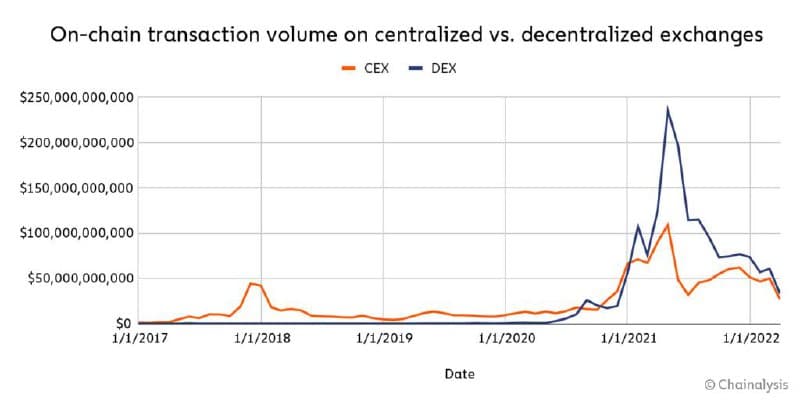
Here's the macro trend that makes this chapter so important: volume is steadily migrating from centralized to decentralized exchanges.
In 2022, decentralized perp DEXs handled roughly 1-2% of total crypto derivatives volume. By 2025, that number crossed 10% and is climbing. The reasons are structural:
- Trust deficit: FTX's collapse showed the world that centralized exchanges can steal your money. Every new scandal pushes more volume on-chain.
- Better tech: Platforms like Hyperliquid proved you don't have to sacrifice speed or UX for decentralization. The gap has closed.
- Composability: On-chain perps can integrate with lending, staking, and other DeFi protocols. CEX perps are siloed.
- Global access: No KYC means a farmer in Nigeria and a developer in Vietnam can access the same markets as a Wall Street trader.
- Airdrop incentives: Let's be honest — the potential for future airdrops has driven massive volume to new DEXs. Hyperliquid proved that early usage can pay off enormously.
This doesn't mean CEXs are dying. Binance and Bybit still dominate total volume. But the direction is clear: on-chain derivatives are growing faster than any other segment in DeFi, and the technology gap between CEX and DEX shrinks every month.
🔮 My take: In 5 years, the idea of depositing funds to a centralized exchange to trade derivatives will feel as outdated as calling your broker to place a stock trade. The infrastructure is being built right now, and Hyperliquid is leading the charge.
Quick Reference: Perp DEX Comparison
- Hyperliquid — Own L1 (HyperBFT) · On-chain order book · CEX speed, no VCs, massive airdrop
- dYdX — Own chain (Cosmos) · Order book · OG perp DEX, battle-tested
- GMX — Arbitrum / Avalanche · GM Pools (oracle-based) · Real yield to LPs
- Vertex — Arbitrum · Hybrid CLOB + AMM · Cross-margin everything
- Drift — Solana · Order book · Fast Solana-native perps
- Jupiter Perps — Solana · JLP pool · Massive Solana user base
- gTrade — Arbitrum / Polygon · Oracle-based · Forex, stocks, commodities (290+ pairs)
- Synthetix — Ethereum Mainnet · Synthetic · Multicollateral margin, L1 custody
Key Takeaways
- Perpetual futures are contracts that let you bet on price direction with leverage — they never expire and are the highest-volume instrument in crypto.
- Funding rates keep perp prices aligned with spot through periodic payments between longs and shorts.
- Leverage is a tool, not a toy. Most leveraged traders lose money. Respect it.
- Hyperliquid built an entirely new blockchain just to run a trading exchange — and it worked. Sub-second execution, fully on-chain, no VC funding, community-first.
- The perp DEX landscape is rich and diverse: dYdX, GMX, Vertex, Drift, Jupiter, gTrade, and Synthetix each bring unique innovations.
- Volume is migrating on-chain. The FTX collapse accelerated it, and better tech is sustaining it. This trend isn't reversing.
What's Next?
Perps are just the beginning of on-chain derivatives. In Part 15, we're going deeper into the derivatives rabbit hole with options and advanced instruments — DeFi protocols that let you trade options, structured products, and exotic derivatives without a TradFi broker. If perps are crypto's stock market, options are its weapons-grade toolkit. See you there.
Stay Updated
Get notified about new posts on automation, productivity tips, indie hacking, and web3.
No spam, ever. Unsubscribe anytime.