Part 21 of 21
You made it.
Twenty chapters. From "what even is a blockchain?" all the way to DeFi protocols, NFTs, Layer 2s, DAOs, and security best practices. If you've followed along — even loosely — you now understand more about crypto than the vast majority of people on the planet. That's not hyperbole. Most people still think Bitcoin is a company.
But knowledge without action is just trivia. This final chapter is about turning everything you've learned into something practical: your strategy. Not my strategy. Not some influencer's strategy. Yours.
Let's build it.
The Right Mindset
Before we talk tactics, let's talk psychology — because crypto will test yours.
This market is volatile. Not "tech stocks had a bad quarter" volatile. More like "your portfolio dropped 40% on a Tuesday because someone tweeted a meme" volatile. If you're not mentally prepared for that, no strategy will save you.
Here's the mindset shift that separates survivors from casualties:
- Think in years, not days. Zoom out. Bitcoin has "crashed" dozens of times and still trends up over any 4-year window in its history.
- Volatility is the price of admission. You don't get 10x returns without stomach-churning drawdowns. That's the deal.
- Have a plan before you need one. Decide now what you'll do when the market drops 50%. If the answer is "panic sell," you're overexposed.
💡 Write your plan down. Literally. "If BTC drops below X, I will ___. If my portfolio is up 3x, I will ___." Future-you will thank present-you when emotions are running high.
Dollar Cost Averaging: The Boring Strategy That Wins
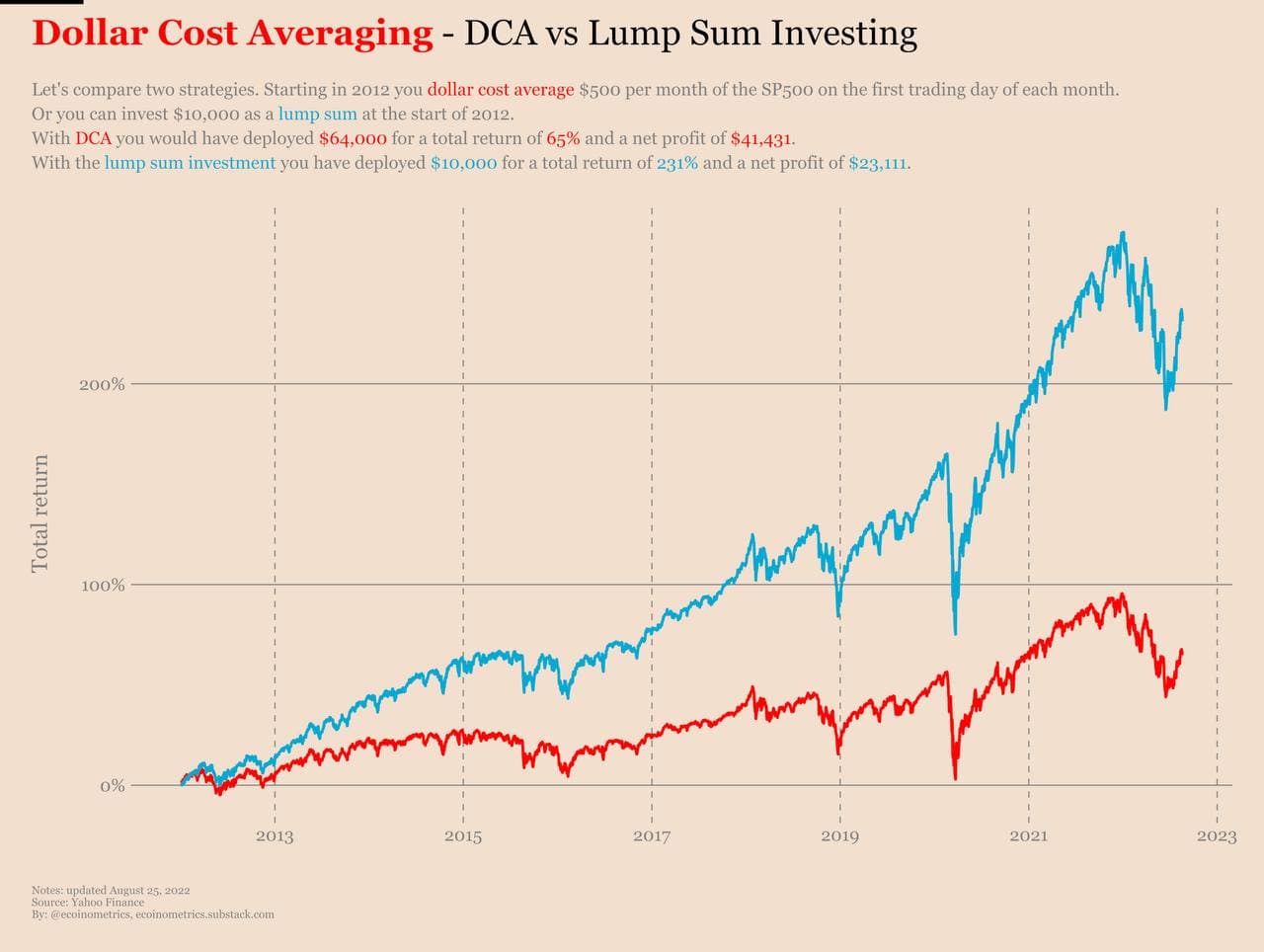
You've heard of DCA by now. It's simple: invest a fixed amount at regular intervals, regardless of price. $100 every week. $500 every month. Whatever fits your budget.
Why does this work?
- It removes emotion. You're not trying to time the bottom or chase the top. You just buy.
- It smooths out volatility. You buy more when prices are low, less when they're high — automatically.
- It's sustainable. You can DCA for years without burning out or blowing up.
Most major exchanges let you set up recurring buys. Do it once, forget about it, and let compounding do its thing. Tools like dcaBTC let you backtest DCA strategies on Bitcoin with real historical data — worth playing with before you commit to a schedule.
💡 The best time to start DCA was yesterday. The second best time is today. Seriously — stop waiting for "the right moment." There is no right moment. There's only consistent action over time.
Does DCA beat lump-sum investing? Research from Vanguard shows that lump-sum investing outperforms DCA roughly two-thirds of the time in traditional markets — but DCA wins on sleep quality. And in a market as volatile as crypto, where drawdowns of 50-80% are routine, that risk-adjusted peace of mind matters more than you think.
Building Your Portfolio
There's no one-size-fits-all portfolio, but here's a framework that works for most people starting out:
The Core-Satellite Approach
- Core (60-80%): Bitcoin and Ethereum. These are your blue chips. They've survived multiple cycles, have the strongest network effects, and carry the least relative risk in crypto. We covered why in Part 2 and Part 3.
- Satellites (10-30%): Altcoins you believe in after doing real research. Maybe a Layer 2 you use daily (remember Part 13?), a DeFi protocol with real revenue, or an infrastructure play. Use Token Terminal to compare protocol revenues before allocating — treat it like evaluating a business.
- Stablecoin Reserve (5-15%): Dry powder. Keep some USDC or DAI on the side so you can buy dips without selling existing positions. This also doubles as your "sleep at night" fund.
Position Sizing: The 1-5% Rule
No single altcoin should be more than 5% of your portfolio. Ideally, keep speculative bets at 1-2%. Why? Because altcoins can — and do — go to zero. If you put 30% of your portfolio into a single token and it collapses, you're not just down money. You're down psychologically, and that leads to worse decisions.
💡 Never invest more than you can afford to lose completely. If losing this money would affect your rent, your groceries, or your relationships — you're overexposed. Scale back. Crypto will still be here when you're in a better position.
Doing Your Own Research (For Real This Time)
"DYOR" is the most repeated and least followed advice in crypto. Let's make it actionable.
On-Chain Research Tools
The beauty of crypto is that everything is transparent. You can verify claims with data instead of trust:
- DefiLlama — Track TVL (Total Value Locked) across every DeFi protocol. If a project claims massive adoption but has $2M in TVL, that's a red flag.
- Dune Analytics — Community-built dashboards for any on-chain metric you can imagine. User growth, transaction volume, revenue — it's all there.
- Token Terminal — Financial metrics for crypto protocols. Revenue, P/E ratios, earnings — treating crypto projects like businesses.
- Nansen — Wallet analytics and smart money tracking. See what top wallets are doing, track whale movements, and identify trends early. Now also offers integrated trading on Solana and Base.
- Arkham Intelligence — On-chain investigation tool. Links wallets to real-world entities through its searchable database. Great for understanding who's behind large movements and tracking specific addresses.
Fundamental Analysis: What Makes a Good Project?
When evaluating any crypto project, ask:
- Team: Who's building this? Are they public, experienced, and accountable? Anonymous teams aren't automatically bad, but they're higher risk.
- TVL & Usage: Are people actually using this protocol, or is it a ghost town with a shiny website?
- Revenue: Does the protocol generate real fees? Where does the money come from? Protocols with sustainable revenue models survive bear markets.
- Tokenomics: What's the supply schedule? Are there massive unlocks coming that will dump the price? Is the token actually needed for the protocol to function, or is it just a speculative vehicle? (We dug into this in Part 6.)
- Community: Is there a real community of users and builders, or just a Telegram full of bots and price speculation?
Reading Smart Contracts (The Basics)
You don't need to be a Solidity developer, but you should know how to do basic verification:
- Go to the contract address on Etherscan
- Check if the contract is verified — this means the source code is public and matches the deployed bytecode
- Look for the "Read Contract" tab to see key parameters: owner, fees, permissions
- Check if there's a proxy pattern (upgradeable contracts) — this means the team can change the contract logic later
If a contract isn't verified, that's a yellow flag. If someone asks you to interact with an unverified contract, think twice. We covered wallet security in Part 9 — those principles apply here too.
Staying Informed Without Losing Your Mind
Crypto moves fast. New protocols launch daily. Market narratives shift weekly. It's easy to feel like you're drowning in information. Here's how to stay current without becoming a full-time crypto analyst:
The Signal Sources
- Crypto Twitter (CT): Still the fastest source of crypto news. Follow builders, not influencers. Look for people who share analysis, not price predictions.
- Newsletters: Bankless for DeFi and Ethereum ecosystem deep dives — their daily brief distills crypto news into 3 minutes. The Defiant for independent news coverage and analysis. Both are excellent signal-to-noise.
- Podcasts: Bankless podcast, Unchained, and Bell Curve for longer-form analysis when you're commuting or working out.
- Protocol-specific: Follow the governance forums and Discord of projects you're invested in. That's where you'll learn about upcoming changes before they hit the news.
Filtering the Noise
The crypto information firehose will drown you if you let it. Some rules:
- Unfollow anyone who only posts price predictions. They're guessing, just like everyone else.
- Ignore "guaranteed" returns. Nothing is guaranteed. If it sounds too good to be true, re-read Part 19 on scams.
- Set time limits. Check crypto news/Twitter once or twice a day, not every 15 minutes. Your portfolio doesn't need hourly babysitting.
- If you're anxious, you're overexposed. This is a reliable signal. Reduce your position until you can sleep.
💡 The best investors are often bored. If crypto is exciting every single day, you're probably overtrading.
The Mistakes That Kill Portfolios
I've watched smart people lose fortunes to these patterns. Don't be one of them:
- FOMO buying: The token is up 200% this week, everyone's talking about it, and you throw money in at the top. By the time you hear about it on social media, the easy gains are gone.
- Panic selling: The market crashes, you sell everything at the bottom, then watch it recover over the next six months. This is the mirror image of FOMO — same emotional driver, same result.
- Overtrading: Every trade has fees. Every swap has slippage. Every transaction is a taxable event in most jurisdictions. The more you trade, the more you leak value.
- Ignoring fees and taxes: Speaking of which — gas fees on L1, trading fees on exchanges, and tax obligations are all real costs. Factor them in. (This is another reason L2s from Part 13 matter so much.)
- Going all-in on one token: Diversification isn't just a TradFi concept. It's survival in crypto.
- Skipping security: Using the same password everywhere, keeping everything on a centralized exchange, clicking random links. One mistake can undo years of gains.
The Long View: Crypto Cycles
Crypto moves in roughly 4-year cycles, loosely correlated with Bitcoin halvings (which we covered in Part 2). Bitcoin's halvings occurred in 2012, 2016, 2020, and most recently April 2024 — each followed by significant bull runs within 12-18 months:
- Accumulation: Prices are flat, sentiment is terrible, builders are building. On-chain metrics like active addresses and developer activity (trackable via Dune dashboards) stay steady even as prices stagnate.
- Bull run: New narratives emerge, prices explode, everyone's a genius.
- Euphoria/blow-off top: Your taxi driver is asking you about altcoins. This is the top. TVL on DefiLlama spikes as leverage and speculation flood in.
- Bear market/crash: Prices collapse 70-90%. Projects die. The cycle resets.
Bear markets are building seasons. The best projects of every cycle were built during the previous bear market. Ethereum was conceived in 2013 and launched in 2015 during Bitcoin's bear market. DeFi Summer (2020) was built on protocols developed during the 2018-2019 bear. Solana's ecosystem exploded in 2023-2024 after being built through the post-FTX collapse winter. If you're paying attention during the quiet times, you'll be positioned for the loud ones.
The investors who win long-term are the ones who survive the drawdowns and keep accumulating when everyone else has given up.
What You've Learned: The 20-Chapter Journey
Let's zoom out on what you now know:
- The fundamentals: Blockchain, Bitcoin, Ethereum, how consensus works, why decentralization matters
- The ecosystem: Altcoins, stablecoins, tokenomics, exchanges, wallets
- DeFi: Lending, borrowing, DEXs, yield farming, liquidity pools
- NFTs and DAOs: Digital ownership, community governance, new organizational models
- Scaling: Layer 2s, rollups, the modular blockchain thesis
- Security: Wallet hygiene, scam recognition, self-custody best practices
- The big picture: Regulation, real-world adoption, where this is all heading
- Strategy: Portfolio construction, risk management, research methodology
That's not a surface-level overview. That's a foundation you can build on for years.
Where to Go From Here
This series gave you the map. Now you walk the terrain:
- Start small. Set up a DCA. Buy some ETH. Use a DeFi protocol with real money (a small amount). Experience is the best teacher.
- Go deeper on what interests you. Loved the DeFi chapters? Dive into yield strategies. Fascinated by L2s? Start using them daily. Intrigued by DAOs? Join one.
- Build. If you're technical, start learning Solidity or contributing to open-source protocols. If you're not, contribute to communities, write about what you've learned, help onboard others.
- Stay patient. The biggest gains in crypto go to those who can sit still for years. Not the ones refreshing CoinGecko every five minutes.
- Bookmark your toolkit. Keep DefiLlama, Dune, Token Terminal, and Nansen in your browser. These are your research command center.
Graduation Day
After completing this series, you now know more than 95% of people talking about crypto on the internet. Most of the noise comes from people who bought a token, don't understand what it does, and are hoping it goes up.
You're different. You understand the technology. You know how to evaluate projects. You know how to protect yourself. You have a framework for building a portfolio that can survive the chaos.
That doesn't mean you won't make mistakes — you will. Everyone does. But you'll make informed mistakes, learn from them faster, and recover more gracefully.
Crypto is still early. The infrastructure is still being built. The regulations are still being written. The killer apps are still being invented. You're not late — you're just in time to understand what's actually happening instead of chasing hype.
So go build your strategy. Start your DCA. Set up your wallet properly. Bookmark DefiLlama. Unfollow the charlatans. And most importantly — enjoy the ride.
It's been a pleasure writing this series. Now get out there.
Welcome to crypto. You're ready. 🎓
Stay Updated
Get notified about new posts on automation, productivity tips, indie hacking, and web3.
No spam, ever. Unsubscribe anytime.