
Part 13 of 21
You walk into a farmers' market. There's no Walmart greeter, no checkout lane, no corporate HQ deciding what goes on the shelves. Farmers show up, set prices, buyers browse, and deals happen peer-to-peer. That's a decentralized exchange — a DEX — but for crypto. No sign-ups, no KYC, no one holding your funds. Just you, your wallet, and a smart contract acting as the world's most transparent middleman.
In Part 12 we covered the differences between centralized and decentralized exchanges. Now let's zoom into where most of DeFi's action actually happens: spot DEXs — the places where you swap one token for another, right now, at market price. There are dozens of them across every chain, each with a different twist. Let's tour the heavyweights.
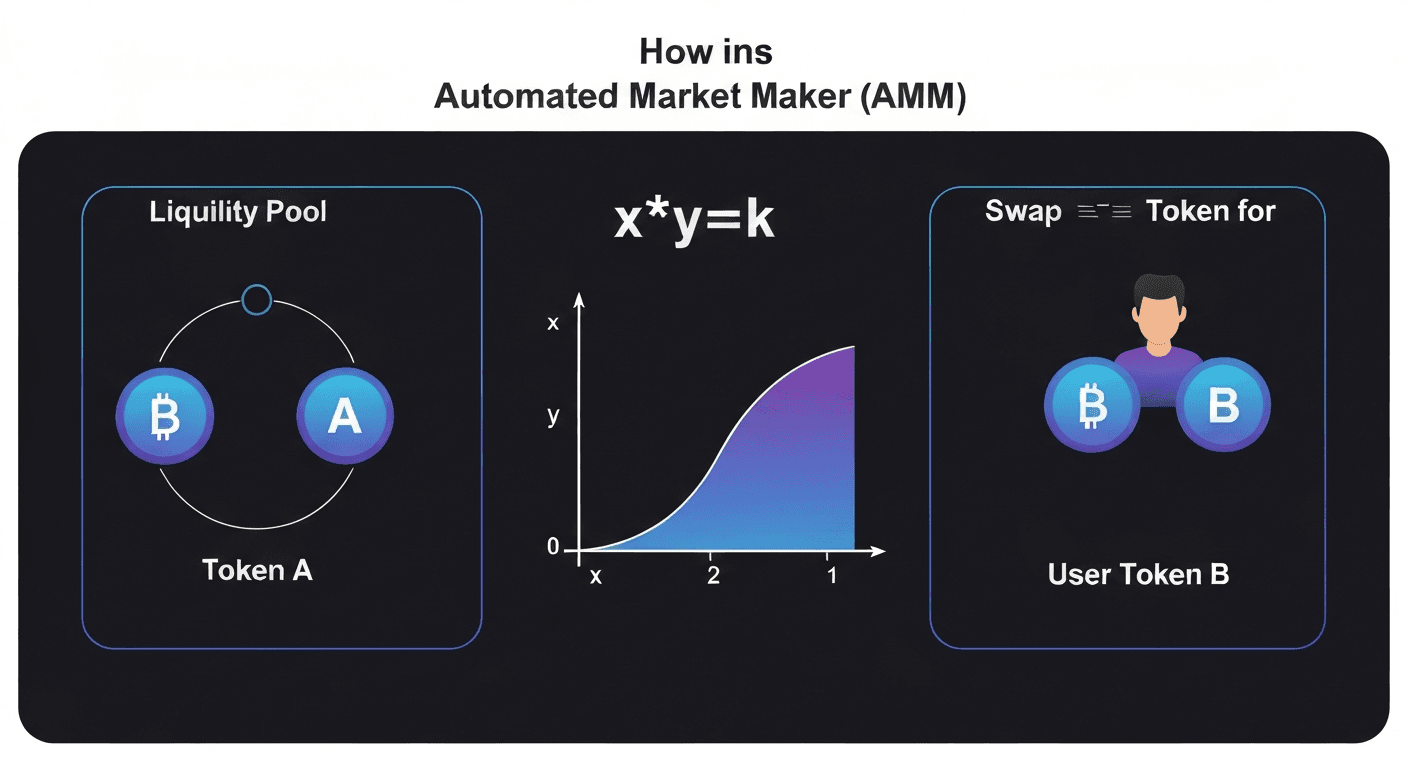
Uniswap — The OG That Changed Everything
If one project kicked off the DEX revolution, it's Uniswap. Launched in 2018 on Ethereum, it proved you don't need an order book to run an exchange. Instead, it introduced the Automated Market Maker (AMM) — a formula (x × y = k) that lets liquidity pools set prices automatically based on supply and demand.
Here's the quick evolution:
- V2 (2020): The classic. Any ERC-20 token pair, simple 50/50 liquidity pools. Worked beautifully but was capital-inefficient — your liquidity was spread across every possible price, even ones that would never get hit.
- V3 (2021): Introduced concentrated liquidity. Instead of spreading money across the entire price range, LPs (liquidity providers) choose a specific range. Think of it like a street musician choosing to play in the busy square instead of an empty alley — same effort, way more tips.
- V4 (2025): Added hooks — customizable plugins that let developers bolt new logic onto pools. Custom fee structures, on-chain limit orders, dynamic fees that adjust with volatility, custom oracle logic, and even entirely custom pricing curves. A new singleton design puts all pools in one contract for massive gas savings, and flash accounting (via EIP-1153 transient storage) nets token transfers so you only pay the final balance. It turned Uniswap from a DEX into a DEX platform.
- Unichain (2025): Uniswap's own Layer 2 chain, built on the OP Stack (Optimism Superchain) and purpose-built for DeFi. 200ms sub-blocks (10× faster than most L2s), executed inside a TEE (Trusted Execution Environment) for MEV protection, with 65% of sequencer revenue committed back to validators. The DEX got its own country.
💡 Beginner tip: Uniswap is the default choice on Ethereum and most EVM chains. If you're swapping tokens on Ethereum, Arbitrum, Polygon, or Base — start here. The interface at app.uniswap.org is clean and battle-tested.
Jupiter — Solana's Swiss Army Knife
If Uniswap is the king of Ethereum DEXs, Jupiter is the emperor of Solana. But Jupiter isn't really a DEX itself — it's an aggregator that routes your trade across every Solana DEX to find the best price. Think of it as a travel search engine that checks every airline for the cheapest flight.
What makes Jupiter special:
- Smart routing: Powered by Jupiter's Juno Liquidity Engine, your swap might hop through Raydium, Orca, and three other pools in a single transaction to minimize slippage. Ultra Swap even simulates executed prices (not just quotes) to pick the route with the least real-world slippage. You don't see any of that complexity — you just get a better price.
- Limit orders: Set a target price and Jupiter fills it when the market gets there. No more staring at charts.
- DCA (Dollar-Cost Averaging): Automatically buy a token in chunks over time. Set it and forget it.
- JLP (Jupiter Liquidity Pool): A basket of assets (SOL, ETH, BTC, stablecoins) that earns fees from Jupiter's perpetual trading platform. It's like an index fund that also earns trading fees.
💡 Pro tip: On Solana, always route through Jupiter rather than going directly to individual DEXs. The aggregation almost always saves you money. Bookmark jup.ag.
Curve — The Stableswap Specialist
Need to swap USDC for USDT? Or one type of wrapped Bitcoin for another? Curve is your place. While Uniswap uses a general-purpose formula, Curve built a custom bonding curve optimized for assets that should trade near the same price — stablecoins, wrapped versions of the same asset, and liquid staking tokens.
The result? Dramatically lower slippage on stable-pair swaps. On Uniswap, swapping $1M of USDC→USDT might cost you in slippage. On Curve, that same trade barely moves the needle.
But Curve's real claim to fame is the Curve Wars — a meta-game of governance and incentives:
- veCRV: Lock CRV tokens to get voting power. Votes direct where Curve's emission rewards flow.
- The Wars: Protocols like Convex and Yearn compete to accumulate veCRV, because controlling those votes means directing yields to their preferred pools. It's like a political lobbying battle, but for liquidity.
Sounds complicated? It is. But as a regular user, you just need to know: Curve = stablecoin swaps and deep stable liquidity.
Raydium — Solana's Hybrid Engine
Raydium was one of Solana's first major DEXs and does something clever: it combines an AMM with an order book (originally sharing liquidity with Serum/OpenBook's central limit order book). This hybrid approach means tighter spreads and more efficient price discovery than a pure AMM.
Raydium is also where a lot of new Solana token launches happen. If a memecoin graduates from a launchpad like Pump.fun, it often migrates to a Raydium pool. That makes Raydium the de facto "listing venue" for Solana's long tail of tokens.
PancakeSwap — The BNB Chain Powerhouse
PancakeSwap did for BNB Chain (formerly Binance Smart Chain) what Uniswap did for Ethereum — but cheaper and with more gamification. It's got:
- The classic AMM swap (now with v3 concentrated liquidity too)
- Lottery and prediction markets
- NFT marketplace
- Multi-chain expansion to Ethereum, Arbitrum, Base, and more
PancakeSwap was the gateway DEX for millions of users who found Ethereum's gas fees too high in 2021. It's still BNB Chain's dominant exchange by a wide margin and remains a solid choice for swaps on that network.
Orca — Solana's Concentrated Liquidity Pioneer
Orca brought concentrated liquidity to Solana with its Whirlpools — think Uniswap V3-style positions but with Solana's speed and low fees. The interface is clean, the UX is beginner-friendly, and it's one of the most capital-efficient DEXs on Solana.
For liquidity providers, Orca's Whirlpools allow much tighter ranges and higher fee capture compared to traditional AMMs. If you're LPing on Solana, Orca is where the sophisticated money goes.
Aerodrome — Base Chain's ve(3,3) King
Aerodrome is the leading DEX on Base (Coinbase's L2), and it runs on the ve(3,3) model pioneered by André Cronje's Solidly and refined by Velodrome on Optimism.
The ve(3,3) model is a governance flywheel:
- Lock AERO tokens → get veAERO (vote-escrowed AERO)
- Vote on which pools receive emissions → earn trading fees and bribes from those pools
- Protocols bribe veAERO voters to direct emissions toward their liquidity → deeper liquidity → more trading → more fees → more bribes
It aligns incentives between the exchange, liquidity providers, and the protocols building on top. Aerodrome exploded in 2024-2025 and became one of the highest-revenue DEXs across all chains.
💡 Why it matters: If you're trading on Base, Aerodrome is likely offering the deepest liquidity. If you want to earn yield, its ve(3,3) model offers compelling rewards for active governance participants.
Trader Joe — The Liquidity Book
Trader Joe started on Avalanche and expanded to Arbitrum and BNB Chain. Its standout feature is the Liquidity Book model — instead of a continuous price curve, liquidity is organized into discrete price bins (think of tiny buckets at exact price points).
This gives LPs precise control over where they deploy capital and results in zero-slippage trades within a single bin. It's a different flavor of concentrated liquidity that some find more intuitive than Uniswap V3's range model.
Osmosis — The Cosmos Hub
In the Cosmos ecosystem, blockchains communicate via IBC (Inter-Blockchain Communication), and Osmosis is the central trading hub that connects them all. It's the place to swap ATOM, OSMO, and dozens of Cosmos chain tokens.
Osmosis is unique because it's its own blockchain — an appchain DEX with custom modules for superfluid staking (stake your LP tokens and secure the network simultaneously). If you're in the Cosmos world, Osmosis is where you trade.
Camelot — Arbitrum's Launchpad DEX
Camelot carved out a niche as Arbitrum's native DEX and launchpad. Beyond standard swaps, it focuses on being a launch partner for new Arbitrum projects — providing initial liquidity, custom pool types, and community-driven incentives.
It features Nitro pools (incentivized staking positions with specific conditions), dynamic directional fees, and a strong community-first ethos. Think of it as the local boutique exchange that knows every new Arbitrum project by name.
| Type | How It Works | Best For | Examples | |------|-------------|----------|----------| | AMM | Liquidity pools + constant product formula | General token swaps | Uniswap, Raydium, Orca | | Stableswap | Optimized curve for same-peg assets | Stablecoin & LST swaps | Curve, Balancer | | ve(3,3) | Vote-escrowed tokens direct emissions to pools | Community-governed liquidity | Velodrome, Aerodrome | | Aggregator | Routes across multiple DEXs for best price | Large swaps, MEV protection | 1inch, CowSwap, Jupiter | | Order Book | On-chain limit orders matched by engine | Precision trading | dYdX, Hyperliquid |
Aggregators — Your Secret Weapon
Here's an important concept: you don't have to pick one DEX. Aggregators check prices across multiple DEXs and route your trade through the optimal path — sometimes splitting it across several pools.
The big three on Ethereum/EVM:
- 1inch: The OG aggregator. Clean interface, Fusion mode for gasless swaps using a Dutch auction mechanism. Works across most EVM chains.
- CowSwap: Uses a unique batch auction system where traders' orders are matched peer-to-peer first (saving on fees), and only the remainder goes to on-chain DEXs. Also offers MEV protection — your trade won't get sandwich-attacked.
- ParaSwap: Another solid aggregator with smart routing and a focus on DeFi power users. Offers a nice API for developers building on top.
💡 The golden rule: For any swap over a few hundred dollars on Ethereum or EVM chains, try an aggregator first. The price improvement often pays for itself compared to going directly to a single DEX. CowSwap is my personal pick for MEV protection.
Quick Reference: Which DEX for Which Chain?
- Ethereum → Uniswap / CowSwap — Deepest liquidity + MEV protection
- Solana → Jupiter — Aggregates everything
- Base → Aerodrome — ve(3,3) flywheel, deepest Base liquidity
- Arbitrum → Uniswap / Camelot — Depends on the token
- BNB Chain → PancakeSwap — Dominant by far
- Avalanche → Trader Joe — Liquidity Book efficiency
- Cosmos → Osmosis — IBC hub
- Stablecoin swaps → Curve — Purpose-built for stable pairs
The Big Picture
What's remarkable is how different each of these DEXs is. They're not just Uniswap clones — they're genuine experiments in market design. Concentrated liquidity, ve(3,3) flywheels, liquidity books, batch auctions, hybrid order books — DeFi is a live laboratory for financial innovation that would take decades to play out in traditional finance.
And remember: on a DEX, you never give up custody of your funds. Your tokens go from your wallet to the smart contract and back — no intermediary holds them overnight. That's the fundamental promise of DeFi.
What's Next?
In Part 14, we're moving from spot trading to the wild world of perpetual DEXs — decentralized platforms where you can trade with leverage, go long or short, and access derivative-style trading without a centralized exchange. We'll do a deep dive into Hyperliquid, the protocol that's challenging CEXs at their own game, plus GMX, dYdX, and the rest of the perps landscape.
Buckle up — it gets spicier from here. 🌶️
Stay Updated
Get notified about new posts on automation, productivity tips, indie hacking, and web3.
No spam, ever. Unsubscribe anytime.